英語の書籍やウェブページを読んだり,動画を視聴したりしていると,よく使われる表現だけでなく,あまり使われない表現も知っておかなければ,意味が理解できない場合があります.数学の話に登場する用語が意外なこともよくあります.直訳しても伝わらない用語,日本ではあまり使われていない用語,辞書に掲載されていない用語にもたくさん出会います.それらの解説と関連する話題や練習問題をまとめています.英語で数学を学ぶ人の参考になれば幸いです.(数式作成にTexのコマンドを使えるMathJaxを利用しています)
Jul 18, 2022
Sextic
Jul 5, 2022
Nature of Roots
Use the discriminant to determine the nature of the roots of quadratic equation.
これなら「2次方程式の根(こん)の自然を決めるには判別式を使う」となりますが, nature には次の意味もあります.
Weblio英和対訳辞書 "nature"
自然、天然、自然界、自然力、自然現象、(人・動物の)本性、天性、性質、本質、特質
なので「2次方程式の根(こん)の性質を調べるには判別式を使う」ということになります.しかし discriminant(判別式)で判別するのは,2次方程式の解が「two distinct real roots(異なる2つの実数解),multiple roots(重解),imaginary roots(虚数解)」(複素数を未習の場合は「虚数解」ではなく「解なし」)のどれになるかということですから,「性質」というのも少し違う気がします.
続いて "nature of" の意味を調べてみると,
Weblio英和対訳辞書 "nature of"
[単数形で; 通例修飾語を伴って] 種類, [the nature] 〔ものの〕本質,特質,特徴
というわけで,nature of roots は「根(解)の種類」と訳すのが正しいようです.したがって,上の文章は「2次方程式の根(解)の種類を決めるには判別式を使う」という意味になります.日本の高校数学Ⅱの教科書でも,「解の種類を判別する」という言い方が使われています.
ところでもともと判別式は,n次方程式が重解を持つ条件を与える式として,19世紀中ごろに英国の数学者 Sylvester が導入しました.$n$次方程式 $$a_nx^n+a_{n-1}x^{n-1}+\cdot\cdot\cdot+a_1x+a_0=0 \quad (a_n \neq 0)$$ の重複を含めた解を $\alpha_1, \cdot\cdot\cdot, \alpha_n$ とすると,$$\prod_{i<j}(\alpha_i-\alpha_j)=0$$になるとき,すなわちすべての異なる(はずの)解の差の積が0になるとき,どれか2つ以上の解が一致するので重解を持ちます.Sylvester はさらに虚数の平方は負になることから虚数解を判別するためにこの式を平方し,式の値を分数にしないようにするために$a_n^{2n-2}$を掛けて,判別式$D$を次の式で与えました.$$D=a_n^{2n-2}\prod_{i<j}(\alpha_i-\alpha_j)^2$$例えば$n=3$なら,$D=a_3^{2・3-2}(\alpha_1-\alpha_2)^2(\alpha_2-\alpha_3)^2(\alpha_1-\alpha_3)^2$となり,これが3次方程式の判別式になりますが,これだけでも計算はかなり複雑です.
では$n=2$にしてみましょう.$$D=a_2^{2・2-2}(\alpha_1-\alpha_2)^2$$ここで2次方程式を $ax^2+bx+c=0$,その重複を含めた解を$\alpha$,$\beta$とすると,解と係数の関係より,$\alpha+\beta=-\frac{b}{a},\quad\alpha\beta=\frac{c}{a}$なので,\begin{eqnarray} D &=& a^2(\alpha-\beta)^2 \\&=& a^2(\alpha^2-2\alpha\beta+\beta^2) \\&=& a^2\left( (\alpha+\beta)^2-4\alpha\beta \right) \\ &=& a^2\left( \left(-\frac{b}{a}\right)^2-4\left( \frac{c}{a}\right) \right) \\&=& b^2-4ac \end{eqnarray}というわけで,お馴染みの2次方程式の判別式を導くことができました.
[Question] (The answer follows after reference)
Find the value of the discriminant, and state the nature of the roots for each equation. (Mathematics SL : Oxford University Press)
a) $x^2+5x-3=0$
b) $2x^2+4x+1=0$
c) $4x^2-x+5=0$
d) $x^2+8x+16=0$
[Reference]
Weblio英和対訳辞書
Discriminant
https://en.wikipedia.org/wiki/Discriminant
代数方程式の判別式
http://hooktail.sub.jp/algebra/Discriminant/
[Answer] (Drag below)
b) 8 ; two different real roots
c) -79 ; no real roots
d) 0 ; two equal real roots
Apr 29, 2022
Aliquot
数学英和・和英辞典(共立出版)には,
aliquot a. 割り切れる,整除できる. n. 割り切れる数,約数. ~ part 約数.
と書かれているので,これだけでは aliquot も同じ「約数」という意味ではないかと思いますが,実は多くの場合,aliquot または aliquot part というのは proper divisor(真約数),すなわちそれ自身を含まない約数を意味します.例えば12の divisors は 1, 2, 3, 4, 6, 12ですが,12の aliquot は 1, 2, 3, 4, 6になります.
関連するものに aliquot sum(アリコット和), aliquot sequence(アリコット数列)があります.aliquotだけ和訳がないのは不思議ですが,元々Latin語の ali (otherの意) とquot (how manyの意)から来ているそうです.
[Reference]
Aliquot sequences
https://www.unirioja.es/cu/jvarona/aliquot.html
aliquot part
https://www.daviddarling.info/encyclopedia/A/aliquot_part.html
May 24, 2021
Closure Property
■発見者の名前がついていない例
Lagrange's mean value theorem(ラグランジュの平均値の定理)
平均値の定理はいくつかあります.その中で日本の高校数学Ⅲで登場する,「グラフ上の2点を結ぶ割線と等しい傾きを持つ接線がその間に存在する」という定理が「ラグランジュの平均値の定理」です.
Varignon's theorem(バリニョンの定理)
日本の中学数学2で出てくる「任意の四角形の各辺の中点を結んでできる四角形は平行四辺形になる」という定理です.
■用語として使われていない例
Scientific Notation(科学表記)
例えば$1.23×10^4$のような数の表し方(2021年度からの学習指導要領で中1で学ぶ内容から中3で学ぶ内容に移りました)をいいますが,日本の教科書では「(整数部分が1けたの数)×(10の累乗)の形」という言い方をしています.
Closure property も用語として使われていない例になります.日本語で「閉性」というので直訳で伝わりますが,日本の教科書では中学数学1と高校数学Ⅰで2回も登場するのに,この用語が使われていないというのが意外なのです.
例えば,整数×整数の結果は必ず整数になるので,このことを"the set of integers is closed under multiplication(整数の集合は掛け算について閉じている)"といいます.逆に,整数÷整数の結果は整数になるとは限らないので,"the set of integers is not closed under division(整数の集合は割り算について閉じていない)"といいます.
このような性質をclosure property(閉性)というのですが,日本の教科書にはこの用語は出てこず,「数の範囲と四則計算の可能性」といって,closedのことを「この範囲でいつでも計算できる」「その範囲で常に計算できる」というような言い方をしています.operation of arity two(2数の演算)の結果がまたその2数の属する集合の元になるという意味なので,この表現は少し違和感を感じますね.
このように2数(ある集合の元2つ)から1つの数(ある集合の元1つ)が得られる演算を,代数学ではbinary operation(二項演算)といい,一般には2つの集合A, Bの Cartesian product(デカルト積)A×B={(a, b)|a∈A,b∈B}からその演算結果の集合C{c|c∈C}へのmapping(写像)で定義されます.例えば$2\div 3=\frac{2}{3}$という計算は,(2, 3)を$\frac{2}{3}$に対応させており,この場合は,整数の集合と整数の集合のデカルト積$\mathbb{Z} \times \mathbb{Z}$から有理数の集合$\mathbb{Q}$へのmappingになっています.
「ある集合が,ある演算について閉じている」という場合は,A=B=Cのときをいい,例えば上の整数の集合$\mathbb{Z} $では,足し算,引き算,掛け算の結果がまた整数になるので,これら3つの演算については閉じているといえます.文献によっては,このように閉じている場合だけをbinary operationという場合があります.
代数学は,以上の事柄を基本として,単位元,逆元の存在,ひとつの演算についての交換法則,結合法則,2つの演算についての分配法則を用いて,群,環,体という概念を定義し,3次,4次,5次方程式解法の理論へと発展していきます.
[Closure Property 問題]
Is the set {-1, 1} closed under addition, subtraction, multiplication and/or division?
解答はこちら
[Reference]
Binary operation
https://en.wikipedia.org/wiki/Binary_operation
因みに,このサイトを参考にするのはいいのですが,日本語Wikiの「二項演算」というページは「この記事は検証可能な参考文献や出典が全く示されていないか不十分です」となっており,内容も英語版とかなり違っていてあまり参考になりませんでした(この投稿公開日現在).
Apr 17, 2021
Vanishing
新車を陸送する仕事の途中,スピード違反で警察に追いかけられても、ただひたすら車を走らせて逃げ続ける男を描いた1971年のアメリカ映画は何でしょう?
Vanishing Point
Sep 9, 2020
Inverse Method
直訳すると「逆の方法」という意味ですが,複数の分野でこの用語が使われています.
Linear Equation(一次方程式)
まず両辺に同じことをして同値関係を保つ「等式の性質」を使って一次方程式を解きます.
① $A=B$ ならば $A+C=B+C$例えば,次のように一次方程式を解いた場合,\begin{eqnarray} 2x+5 &=& 13 \\ 2x+5-5 &=& 13-5 \\ 2x &=& 8 \\ \frac{2x}{2} &=& \frac{8}{2} \\ x &=& 4 \end{eqnarray}(a) 1行目の$+5$に対して2行目で両辺にその逆をする,すなわち$5$を引く
② $A=B$ ならば $A-C=B-C$
③ $A=B$ ならば $AC=BC$
④ $A=B$ ならば $A/C=B/C$
(b) 3行目の$2$×$x$に対して4行目で両辺にその逆をする,すなわち$2$で割る
以上の方法を inverse method といいます.
この意味を理解した後で次のように解くことができます.\begin{eqnarray} 2x+5 &=& 13 \\ 2x &=& 13-5 \\ 2x &=& 8 \\ x &=& \frac{8}{2} \\ x &=& 4 \end{eqnarray}(a) $+5$を右辺に移して$-5$にする transposing the term(移項)
(b) $2x$の$2$を右辺の分母に移す
以上の方法を transpose method といいます.

Simultaneous Equation(連立方程式)
簡単な例として,次の2元1次連立方程式\begin{eqnarray} \left\{ \begin{array}{l} x + y = 10 \\ 2x + 4y = 32 \end{array} \right. \end{eqnarray}を行列で表して解くと.\begin{eqnarray} \begin{pmatrix} 1 & 1 \\ 2 & 4 \end{pmatrix}\begin{pmatrix} x \\ y \end{pmatrix} &=& \begin{pmatrix} 10 \\ 32 \end{pmatrix}\\ \begin{pmatrix} x \\ y \end{pmatrix} &=& \begin{pmatrix} 1 & 1 \\ 2 & 4 \end{pmatrix}^{-1}\begin{pmatrix} 10 \\ 32 \end{pmatrix}\\ \begin{pmatrix} x \\ y \end{pmatrix} &=& \begin{pmatrix} 2 & -\frac{1}{2} \\ -1 & \frac{1}{2} \end{pmatrix}\begin{pmatrix} 10 \\ 32 \end{pmatrix}\\ \begin{pmatrix} x \\ y \end{pmatrix} &=& \begin{pmatrix} 4 \\ 6 \end{pmatrix}\\ \end{eqnarray}
このように,n元1次方程式が行列で$AX=B$と表されている場合,解$X$を求めるのに,左から$A^{-1}$を掛けて,$X=A^{-1}B$と求める方法も inverse method といいます.
[Quiz]
演算の逆はinverse,では命題の「逆」は英語で何というでしょう?
[Answer](この下の行をドラッグしてください)
Converse
[Reference]
How to Use the Transpose Method to Solve a Linear Equation? | Don't Memorise
https://www.youtube.com/watch?v=JQpKKXOSwlc
Aug 1, 2019
HCF (Highest Common Factor)
![]() |
| Youtube: HCF or GCD |
Q. What is the difference between the HCF and the GCD of two numbers? Is there any difference at all?
A. They are the same. Whereas Highest Common Factor (HCF) is a little bit old-fashioned, but still in use today.
I studied in the UK, and my Discrete Maths teacher (who was 70 years old) used to say that when he was a student, all profs use HCF than GCD and he pointed out that GCD is an American term (he stressed on the rrr in divider).
As I have been taking more lectures in maths, I realised that applied maths lecturers use HCF more than pure maths lecturers.
There is a tendency in which the terminologies of maths standardise, and now I barely heard the term HCF. For myself, I use GCD more than HCF but I still tell people that my old professors prefer the latter.
I simply miss the time when we had diversity of terms.
(Quora.com)
To factorise an algebraic expression, take out the highest common factor and place it in front of the brackets. Then the expression inside the brackets is obtained by dividing each term by the highest common factor.
(mathteacher.com)例えば,$3a^4b+12a^2b^3=3a^2b(a^2+4b^2)$ と因数分解できますが,このときの HCF は $3a^2b$ ということになります.
Feb 8, 2019
Radicals and Surds
Radicalsというと,政治用語の「過激派」とか「急進主義者」という意味をまず思いつきます.もともとradicalはラテン語のradix(根)という言葉を語源として「根本的」という意味なのですが,根本的に政治を変えようとする集団のことをradicalsと呼んだことからこのような意味にも使われるようになったそうです.
数学用語としての radical は根号のついた数,累乗根(n乗根)$\sqrt[n]{x}$という意味があり,$\sqrt[n]{x}$は普通"the $n$th root of x"と読みますが,"x radical $n$"と読むこともあります.例えば$\sqrt{3}$,$\sqrt{4}$,$\sqrt[3]{5}$などが radicals です.根号はradical symbol, radical sign, root simbolとも呼ばれています.
Surd の対訳は「根数」または「不尽根数」で,radicals の中で無理数であるもの,すなわち循環しない無限小数になるものをいいます.例えば$\sqrt{4}$はradicalですが無理数ではないので surd ではありません.一方,$\sqrt{3}$はradicalで無理数なので surd になります.円周率πやネイピア数eは根号表示されない無理数なので,radical でも surd でもありません.
A radical is a number that is written using the radical sign $\sqrt{\quad}$. Radicals such as $\sqrt{4}$ and $\sqrt{9}$ are rational since $\sqrt{4}$= 2 and $\sqrt{9}$= 3. Radicals such as $\sqrt{2}$, $\sqrt{3}$ and $\sqrt{5}$ are irrational. They have decimal expansions which neither terminate nor recur. Irrational radicals are also known as surds.Surdという言葉は元々ラテン語のsurdus(deaf, silent)から派生したもので,無声音→聞こえない→感覚がない→不合理→irrationalというわけで,radicals のうち irrational であるものを surd と呼ぶようになったようです.
(Haese Mathematics, MYP Gr.9-10, Radicals and Surds)
[Radicals and Surds 問題]
(1) Which of the following is a surd?
(a) $\sqrt {64}$ (b) $\sqrt {18}$ (c) $\sqrt {100}$
(2) Rationalise the denominator of $\frac{5}{4-\sqrt{6}}$
正解はこちら
[Reference]
Mathematics for the international student Pre-Diploma SL and HL (MYP 5 Plus)
Haese Mathematics
Surds - Math is Fun
https://www.mathsisfun.com/surds.html
Merriam-Webster dictionary/surd
https://www.merriam-webster.com/dictionary/surd
Jan 30, 2019
Continued Square Roots
![]() |
| Mathematics for the international student Pre-Diploma SL and HL (MYP 5 Plus) Presumed Knowledge for SL and HL courses (HAESE Mathematics) |
[Continued Square Roots 問題]
Find the value of x.$$\sqrt{6+\sqrt{6+\sqrt{6+\sqrt{6+...}}}}=x$$解答はこちら
[Reference]
Mathematics for the international student
Pre-Diploma SL and HL (MYP 5 Plus) Presumed Knowledge for SL and HL courses
(HAESE Mathematics)
Continued Square Root
http://mathworld.wolfram.com/ContinuedSquareRoot.html
Sep 24, 2018
Direct Variation
y is directly proportional to x
といいます.正比例することを「比例する」ともいいますが,英語でもdirectなしで,proportionalityとか,proportionalとかいいます.すなわち,yがxに比例するというのに,
y is proportional to x
でもいいわけです.そして,どちらもy=kx(kは比例定数)という関係式になり,時にはy∝xとも表されます.
![]() |
| https://www.openalgebra.com/2012/11/variation.html |
y varies directly with x
または
y varies directly as x
とも表現されます.
![]() |
| https://www.onlinemathlearning.com/joint-variation.html |
y is inversely proportional to x
y varies inversely with x
y varies inversely as x
などと表され,関係式は$y=\frac{k}{x}$となります.
因みに,joint variation, combined variationという用語もあり,joint variationは2変数以上の積に比例し,その関係式は2変数の場合y=kxzになります.また,combined variationは2変数以上の積や商に比例し,その式は例えば$y=\frac{kz}{x}$などとなります.
[Direct Variation 問題]
The area of an ellipse varies jointly as a and b, that is, half the major and minor axes. If the area of an ellipse is 300 pi square units when a = 10 and b = 30 units then what is the constant of proportionality? Give a formula for the area of an ellipse.
解答はこちら
[Reference]
Variation
https://www.openalgebra.com/2012/11/variation.html
Joint and Combined Variation Word Problems
https://www.onlinemathlearning.com/joint-variation.html
Jun 10, 2018
Pronumeral
![]() |
| A MATHS DICTIONARY FOR KIDS |
Wiktionary英語版で,数学用語としての variable の意味は次のようになっています.
(mathematics) A quantity that may assume any one of a set of values.このように文字で表わされた定数も variable というなら,variable と pronumeral は同じ意味になります.例えば$y=ax^2+bx+c$なら,$a, b, c$ も $x, y$ も pronumeral ということになります.
(mathematics) A symbol representing a variable.
この用語 pronumeral がなぜ意外なのかというと,Australia以外でほとんど使われていないからです.Wiktionary英語版では pronumeral が以下のように紹介されています.
Usage notes同僚の理系の米国人はこの用語を知りませんでした.確かにAustraliaから出版されている複数のInternational Baccalaureate(IB=国際バカロレア)の教科書にはこの pronumeral が使われていました.
Standard in Australian compulsory education, but rarely used outside Australia.
![]() |
| MATHEMATICS for year 8 (Haese Mathematics : Australia) |
IB Diploma Program(IB資格を取得するための高2~高3対象プログラム)Mathの教科書は,Australiaの3社(Haese, IBID, Pearson)と英国の2社(Oxford, Cambridge)から出版されていますが,Australiaの教科書も世界中でかなり使われていますので,この用語 pronumeral も知っておいた方がいいでしょう.
[Pronumeral問題]
Find the following pronumeral in the diagrams below. (SOCRATIC)
[Reference]
A MATHS DICTIONARY FOR KIDS
http://www.amathsdictionaryforkids.com/qr/p/pronumeral.html
SOCRATIC Trigonometric Questions
https://socratic.org/questions/how-to-find-the-following-pronumeral-in-the-diagrams-below
Nov 2, 2017
Asymmetry & Antisymmetry
Asymmetry の日本語訳は非対称.読み方は æsímətri or eisímətri の2通りあります.カタカナでなるべく実際の発音に似せるとアシマトウリまたはエイシマトウリとなります.
Antisymmetry の方の日本語訳は反対称,これも読み方が ænti-símətri or æntɑɪ-símətri と2通りあり,前者は英国でアンチシマトウリ,米国でアニシマトウリ,後者はアンタイシマトウリになります(同僚の米国人に教わりました).
では asymmetry と antisymmetry の意味の違いは何でしょうか.どっちも対称でないのですから,同じやん(大阪弁)といいたくなりますね(笑).しかし,数学では明確な違いがあります.
[Binary relation(二項関係)における symmetric relation(対称関係), asymmetric relation(非対称関係)and antisymmetric relation(反対称関係)]
Binary relation の最も簡単な例は2つの数の関係です.aからbへRという関係があるとき,aRbと表します.例えば3>2などの関係です.
■「aからbへの関係が成り立つならば,bからaへの関係も成り立つ」という場合,symmetric relation といいます.すなわち,$$\ aRb\;\Rightarrow bRa$$例えばRが=という関係のとき,a=bならばb=aも成立するので symmetric relation になります.
■「aからbへの関係が成り立つならば,bからaへの関係が成り立たない」という場合,asymmetric relation といいます.すなわち,$$\ aRb\;\Rightarrow \lnot (bRa)$$例えばRが>という関係のとき,a>bならばb>aは成立しないので asymmetric relation になります.
■「aからbへの関係が成り立ち,かつbからaへの関係も成り立つならば,a=bが成り立つ」という場合,antisymmetric relation といいます.すなわち,$$\ aRb\land bRa\ \Rightarrow a=b$$例えばRが≧という関係のとき,a≧bかつb≧aならばa=bが成立するので antisymmetric relation になります.また,集合の包含関係でも次式が成り立つので,antisymmetric relation といえます.
[関数/整式/行列などの asymmetry(非対称性)と antisymmetry(反対称性)]
■Symmetry なグラフといえば正規分布ですが,その峰が左右にずれた場合,asymmetry な曲線になります.分布の非対称性を示す指標を skewness(歪度=わいど )といい,峰が右にずれて左が低い場合(J型)の歪度は負,左右対称であれば歪度は0,峰が左にずれて右が低い場合(L型)の歪度は正になります.
■Antisymmetry は,「ある変換をした結果が逆の符号になるもの」をいいます.
例えば関数y=f(x)で,f(-x)=f(x)となる偶関数は symmetry,f(-x)=-f(x) になる奇関数は antisymmetry になります.しかし奇関数は rotational symmetry with respect to the origin(原点対称)なので広義では symmetry ともいえます.
また整式 f(x,y) で,xとyを入れ替えても変わらない対称式,例えば x+y は symmetry であり,xとyを入れ替えると符号が変わる交代式,例えば x-y は antisymmetry になります.
さらに行列でも,行列$A$に対してその transpose(転置行列)$A^T$が等しいときは symmetry,符号が逆になるものは antisymmetry になります.因みに行列式も,行か列を入れ替えると次のように符号が変わるので antisymmetry になります.
[Reference]
Binary relation
https://en.wikipedia.org/wiki/Binary_relation
反対称性
https://ja.wikipedia.org/wiki/%E5%8F%8D%E5%AF%BE%E7%A7%B0%E6%80%A7
Symmetry in mathematics
https://en.wikipedia.org/wiki/Symmetry_in_mathematics
Sep 28, 2017
LHS and RHS
解答の右側の{ }の1行目は「定数を右辺へ移項する」,2行目は「平方完成する」,3行目は「左辺を因数分解する(factoriseはUK式表現)」という意味なので,LHSは左辺,RHSは右辺を意味していると分かります.これらはleft-hand side,right-hand sideを省略した表現になっています.因みに横の吹き出しは「両辺に加える平方数はxの係数の半分の2乗」だと言っています.
長い用語を頭文字だけで表すabbreviation(略語)はよく目にします.新たにひとつの単語のように読むものをacronym(頭字語)といいますが(FOIL Methodで登場),アルファベットだけをそのまま読む場合はinitialismといいます.LHS & RHSはinitialismになります.他にも数学に関連するものを少し見てみましょう.
SSS, SAS, ASA, RHA, RHS, HL(Hypotenuse Leg Theorem, Donkey Theorem で登場)ここにもRHSがありましたね.こちらは right angle hypotenuse side の省略で,三角形の合同条件「直角三角形の斜辺と他の1辺が等しい」という意味になります.
SOHCAHTOA(SOHCAHTOAで登場した三角比の覚え方),他によく知られたもので,GCD(greatest common divisor=最大公約数),LCM(least common multiple=最小公倍数),QED(quod erat demonstrandum=証明終り),SD(standard deviation=標準偏差)などいろいろ思い浮かびますね.SDは,一般にはSDカード(secure digital memory card)が有名ですが,日本語をinitialismにしてしまうタレントのDAIGOさんによると,「外に出る」だそうです(笑).
他に対になっているものとしては,ODE (ordinary differential equation=常微分方程式) & PDE (partial differential equation=偏微分方程式) ,FTA (Fundamental Theorem of Algebra=代数学の基本定理) & FTC (Fundamental Theorem of Calculus=微分積分学の基本定理)などがあります.
Abbreviations.comというサイトには多数の略語が紹介されています.数学だけでも3000を超えています.そこには,LHSは一つだけだったのに対し,RHSは3つありました.あともう1つは rectangular hollow section(長方形中空断面)でした.このサイトでたまたまWME=Women and Mathematics Educationというのを見つけたので,何だろうと思って調べてみたら,こういう名称の団体であることが分かりました.
[Reference]
The difference between an acronym and an initialism
http://www.todayifoundout.com/index.php/2012/05/the-difference-between-an-acronym-and-an-initialism/
Abbreviations.com
http://www.abbreviations.com/
Aug 5, 2017
Diophantine Equations
Diophantine Equations(ディオファントス方程式)は,係数が整数で$ax+by=c$や$x^2+y^2=z^2$などの形をしたindeterminate equation(不定方程式=解が無数に存在する方程式)の総称で,他にもいくつかのパターンがあります.この中のひとつ,2012年からの日本の高等学校「数学A」に登場した「整数の性質」(2022年度から廃止)で学んだ$ax+by=c$の形の不定方程式は,cがaとbの最大公約数またはその倍数のときに整数解(x, y)が存在し,Bézout's identity(ベズーの等式)と呼ばれています.
簡単な例として,
もし最初に見つけた解が$(2,-1)$なら,同様にして
ところが,
因みに,碑文の問題はDiophantus's riddle(謎)とかDiophantus puzzle(パズル)とか呼ばれていて,一次方程式の応用問題としても有名ですが,Nintendo DSというゲームの"Professor Layton and Pandora's Box(レイトン教授と悪魔の箱)"の第142問目にも登場します.
【Diophantine Equations 問題】
(1) Two farmers agree that pigs are worth 300 dollars and that goats are worth 210 dollars. When one farmer owes the other money, he pays the debt in pigs or goats, with "change" received in the form of goats or pigs as necessary. (For example, a 390 dollar debt could be paid with two pigs, with one goat received in change.) What is the amount of the smallest positive debt that can be resolved in this way?
(A) 5 (B) 10 (C) 30 (D) 90 (E) 210
(2) Jack and Jill visit the cake shop every day, and Jack always buys jam doughnuts, and Jill chocolate éclairs. The jam doughnuts cost 0.95 each and the chocolate éclairs cost 0.97. At the end of the week the non-itemised bill from the cake shop is 42.38. How much must each pay?
(解答はこちら)
[Reference]
Diophantus's Riddle
http://mathworld.wolfram.com/DiophantussRiddle.html
Diophantine equation
https://en.wikipedia.org/wiki/Diophantine_equation
Diophantine equation
http://artofproblemsolving.com/wiki/index.php?title=Diophantine_equation
Number Theory Using Modular Arithmetic to Solve Indeterminate Equations
https://trans4mind.com/personal_development/mathematics/numberTheory/indeterminateEquationsCongruences.htm

Jul 24, 2017
Babylonian Method
\begin{align}
&\frac{1}{2}\left( 2+\frac{5}{2} \right)=\frac{9}{4}=2.25\\
&\frac{1}{2}\left( \frac{9}{4}+\frac{5}{\frac{9}{4}} \right)=\frac{161}{72}=2.236111111\cdot\cdot\cdot\\
&\frac{1}{2}\left( \frac{161}{72}+\frac{5}{\frac{161}{72}} \right)=\frac{51841}{23184}=2.236067978791\cdot\cdot\cdot\\
\end{align}$\sqrt{5}=2.236067977499\cdot\cdot\cdot$なので,3回の計算で驚くほど速く$\sqrt{5}$に近づいたことが分かります.この方法はBabylonian MethodまたはHero's method(Heroはあのヘロンの公式のヘロンと同一人物)と呼ばれています.
この式をよく見ると,$a$と$\frac{5}{a}$のarithmetic mean(算術平均=相加平均)を求める式になっています.面積が$s$になる長方形の1辺を$a$とすると,他の1辺は$\frac{s}{a}$になるので,これらの算術平均を新たな$a$として同じ計算を繰り返すと,正方形の1辺に近づいていくというわけです.
一般に$\sqrt{s}$を求める場合を漸化式で表せば次式になります.$$x_{n+1}=\frac{1}{2}\left( x_n+\frac{s}{x_n} \right)$$極限では$x_{n+1}$も$x_n$もほぼ同じなので,その値をαとおいて上式に代入すると,$$α=\frac{1}{2}\left( α+\frac{s}{α} \right)$$整理すれば,$α^2=s$すなわち,$α=\pm\sqrt{s}$となります.
これは17世紀頃に発見されたNewton's Method(ニュートン法)$$x_{n+1}=x_n-\frac{f(x_n)}{f'(x_n)}$$に$f(x)=x^2-s$を当てはめた式と同じになりますが,もちろん,Babylonian Methodの方がずっと早くに知られていたことになります.
急速に近似する様子を確かめるものをGeoGebraでつくってみました.試してみてください.
因みに,平方根の近似値を求める方法は,小数点から 2 桁ずつ区切って割り算のようにする方法 extraction of square root(開平法)がよく知られています.
<Reference>
Methods of computing square roots
https://en.wikipedia.org/wiki/Methods_of_computing_square_roots
Jun 9, 2017
Section Formula
![]() |
| conic section |
section formulaといえばその関係の公式だと思ってしまいますが,これは2点A(x1),B(x2)を結ぶ線分ABをm:nに分ける点の公式$$\frac{mx_2+nx_1}{m+n}$$のことをいいます(n>0で内分,n<0で外分).でもよく見ると分子の項の順番が違いますね.日本の教科書では次の式のほうが一般的です.$$\frac{nx_1+mx_2}{m+n}$$もちろんどちらも同じ値になりますが,海外では上の式のほうが一般的です.
この式のnを正の数に限定してinternal division(内分)とexternal division(外分)を式で区別するなら,上の2式は内分点,次の2式は外分点になります.どちらが覚えやすいでしょうか.$$\frac{mx_2-nx_1}{m-n}$$$$\frac{-nx_1+mx_2}{m-n}$$
この公式は,coordinate geometry(座標幾何)だけでなく,vector(ベクトル)やcomplex plane(複素平面)でも登場するうえ,物理学ではcenter of gravity(重心)(またはcenter of mass(質量中心)ともいう)などを求めるのにも使われます.
この公式を使う文章題は見たことがなかったので,簡単なものを作ってみました.この公式を使って解いてみてください.
(問題)一直線の道で,Aさんが家から東へ2kmの地点に,Bさんが家から東へ8kmの地点にいる.Aさんは自転車で時速11km,Bさんは徒歩で時速5kmで進む.(1) お互い向かい合って進むとき,家から何kmの地点で出会うか.
(2) お互い家から遠ざかる方向へ進むとき、家から何kmの地点でAさんがBさんに追いつくか.
(正解は右図です)
<reference>
Section Formula
https://brilliant.org/wiki/section-formula/
質量中心
http://www14.plala.or.jp/phys/tools/10.html
Oct 6, 2016
Method of Differences
そのひとつは,telescoping series(望遠鏡級数または畳み込み級数)、すなわち,中の符号の異なる項が次々に消えていき,最初と最後の和で全体の和が求まるような級数,例えば$$\sum_{k=1}^n \frac{1}{k(k+1)}=\sum_{k=1}^n\left(\frac{1}{k}-\frac{1}{k+1}\right)$$のような級数ですが,このようなtelescoping sum(望遠鏡和または畳み込み和)を用いる方法をmethod of differences といいます.このtelescopingは,いくつか半径の異なる鏡筒でできた望遠鏡を畳み込むと最初から最後までの鏡筒がひとつにまとまることから来ています.
一方,difference sequence(階差数列)を考えて一般項を求める方法も method of differencesと呼ばれています.(a)初項に階差数列のn-1項の和を加える方法の他に,(b)二項定理に似た方法,(c)連立方程式を用いる方法があります.
(a)初項に階差数列のn-1項の和を加える方法
元の数列{an}の第1階差数列を{bk}とするとき,an=a1+Σbk(ただしΣはn-1までの和)で求めます.第2階差{cn},第3階差{dn}まで考えるときも,{dn}から{cn}を求め,{cn}から{bn}を求め,{bn}から{an}を求めます.
<例1> (第2階差数列が定数列になるとき、もとの数列を2階等差数列といいます)
{an} 5, 10, 17, 26, 37, …
{bn} 5, 7, 9, 11, …
{cn} 2, 2, 2, ….
an=5+Σ(2k+3)(ただしΣはn-1までの和)
=n^2+2n+2
<例2> (3階等差数列)
{an} 2, 12, 36, 80, 150, 252, …
{bn} 10, 24, 44, 70, 102, …
{cn} 14, 20, 26, 32, …
{dn} 6, 6, 6, …
bn=10+Σ(6k+8)
=3n^2+5n+2
an=2+Σ(3k^2+5k+2)
=n^3+n^2
(b)二項定理に似た方法
a1=a1(係数が1)
a2=a1+b1(係数が1,1)
a3=a2+b2
=a1+b1+b1+c1
=a1+2b1+c1(係数が1,2,1)
a4=a3+b3
=a1+2b1+c1+b1+2c1+d1
=a1+3b1+3c1+d1(係数が1,3,3,1)
...
an=a1+n-1C1・b1+n-1C2・c1+n-1C3・d1+...(+0になるまで)
<上と同じ例1> (2階等差数列)
{an} 5, 10, 17, 26, 37, …
{bn} 5, 7, 9, 11, …
{cn} 2, 2, 2, …
an=5+(n-1)・5+{(n-1)(n-2)/2}・2 (cnの次から0なのでc1で終わり)
=n^2+2n+2
<上と同じ例2> (3階等差数列)
{an} 2, 12, 36, 80, 150, 252, …
{bn} 10, 24, 44, 70, 102, …
{cn} 14, 20, 26, 32, …
{dn} 6, 6, 6, …
an=2+(n-1)・10+{(n-1)(n-2)/2}・14+{(n-1)(n-2)(n-3)/3!}・6 (dnの次から0なのでd1で終わり)
=n^3+n^2
<例3 [Explicit Formula 問題]に出てきたMoser's Circle Problem> (4階等差数列)
{an} 1, 2, 4, 8, 16, 31, …
{bn} 1, 2, 4, 8, 15, …
{cn} 1, 2, 4, 7, …
{dn} 1, 2, 3, …
{en} 1, 1, …
an=1+(n-1)・1+(n-1)(n-2)/2・1+(n-1)(n-2)(n-3)/3!・1+(n-1)(n-2)(n-3)(n-4)/4!・1 (enの次から0なのでe1で終わり)
=1/24(n^4−6n^3+23n^2−18n+24)
(c)連立方程式を用いる方法
第m階差数列が定数列になるとき、もとの数列をm階等差数列といいますが,m階等差数列なら一般項がm次式になることが分かっているので,anをnのm次式とおいて,係数を連立方程式を解いて求めます.
<上と同じ例1> (2階等差数列 m=2の場合)
{an} 5, 10, 17, 26, 37, …
{bn} 5, 7, 9, 11, …
{cn} 2, 2, 2, …
an=an^2+bn+cとおいて,
a1= a+ b+ c= 5
a2=4a+2b+c=10
a3=9a+3b+c=17
を解くと,a=1, b=2, c=2を得るので,
an=n^2+2n+2
<上と同じ例2> (3階等差数列 m=3の場合)
{an} 2, 12, 36, 80, 150, 252, …
{bn} 10, 24, 44, 70, 102, …
{cn} 14, 20, 26, 32, …
{dn} 6, 6, 6, …
an=an^3+bn^2+cn+dとおいて,
a1= a+ b+ c+ d= 2
a2=8a+4b+2c+d=12
a3=27a+9b+3c+d=36
a4=64a+16b+4c+d=80
を解くと,a=1, b=1, c=0, d=0を得るので,
an=n^3+n^2
図はこの連立方程式を解いたTI84というGDC(グラフ電卓)の画面です.このrrefは与えられた行列[A]を左基本変形した行列(reduced row-echelon form)を示しています.
<Reference>
望遠鏡和
http://integers.hatenablog.com/entry/2015/11/27/200158
Mathematics Higher Level (Core) 3rd Edition (IBID Press)
Finding the Next Number in a Sequence: Common-Difference Examples
http://www.purplemath.com/modules/nextnumb2.htm
Sep 20, 2016
Explicit Formula
日本の高校数学の教科書で,数列の項はa1, a2, a3,…でを表す場合が多いのですが,英書ではu1, u2, u3,…がよく使われ,GDC(グラフ電卓)でもSEQモード(数列モード)にするとuが使われています.これはある用語の頭文字ではないかなと思って調べてみたら,こんな文章が見つかりました.
If a sequence is composed of elements or terms it belonging to some set S, then it is conventional to indicate their order by adding a numerical suffix to each term. Consecutive terms in the sequence are usually numbered sequentially, starting from unity, so that the first few terms of a sequence involving u would be denoted by u1, u2, u3,... . Rather than write out a number of terms in this manner this sequence is often represented by {un}, where un is the nth term, or general term, of the sequence.
Mathematics for Engineers and Scientists, Sixth Edition (Alan Jeffrey)というわけで,1を意味するunityから来ているようです.調べる前はunitではないかと思ったのですが,当たらずとも遠からずでした.
等差数列は直訳のsequence of numbers with common differenceよりもarithmetic progressions(略してAPs)またはarithmetic sequence(直訳は算術数列)という言い方が多いです.これは等差数列a, b, cの等差中項$b=\frac{a+c}{2}$はarithmetic means(算術平均または相加平均)でもあるからです.同様に等比数列もgeometric progressions(略してGPs)またはgeometric sequence(直訳は幾何数列)といいます.これは等比数列a, b, cの等比中項$b=\sqrt{ac}$はgeometric means(幾何平均または相乗平均)でもあるからです.
[Explicit Formula 問題]
![]() |
| Moser |
a) Draw the cases n = 4 and n = 5.
b) Use the cases n = 1, 2, 3, 4, 5 to form a conjecture about the number of regions formed in the general case.
c) Draw the case n = 6. Do you still believe your conjecture?
(正解はこちら)
<Reference>
Mathematics for Engineers and Scientists, Sixth Edition (Alan Jeffrey)
Mathematics HL (Core) for use with IB Diploma Programme third edition (Haese Mathematics)
Aug 29, 2016
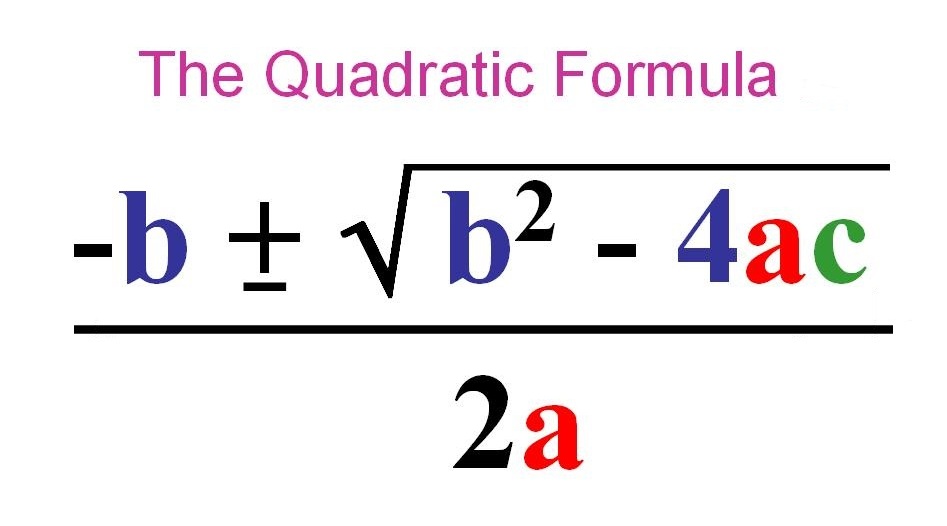
Quadratic Formula
The Latin prefix quadri- is used to indicate the number 4, for example, quadrilateral, quadrant, etc. However, it also very commonly used to denote objects involving the number 2. This is the case because quadratum is the Latin word for square, and since the area of a square of side length x is given by x^2, a polynomial equation having exponent two is known as a quadratic ("square-like") equation.ラテン語の接頭辞quadriは4という数字を示しているが,2という数字を含むものも表していた.Quadratumはラテン語の正方形という意味であり,その1辺をxとすると面積はxの2乗になることから,2乗を含む方程式はquadraticな(正方形的な)方程式として知られていた.という理由のようです.
というわけで,quadratic formulaは二次方程式の解の公式のことです.Quadratic Formula Song(解の公式の歌)が動画サイトで多数見つかります.親しみやすそうなものを2つ選んでみました.
♪Pop! Goes the Weasel
<Math Version>
x equals negative b
plus or minus the square root
of b squared minus 4ac
all over 2a
<Actual Song>all over 2aはこの前がすべて分子で2aが分母という意味です.また,'twasは"it was"の省略形です.
All around the mulberry bush,
The monkey chased the weasel.
The monkey thought 'twas all in fun.
Pop! goes the weasel.
桑の木の周りで
サルがイタチを追っかけた
サルはとても楽しんだ
イタチがぴょんと跳ねた
♪Row Row Row Your Boat
<Math Version>
x equals opposite b
plus or minus the square root
of b squared minus 4ac
divided by 2a
<Actual Song>なぜnegative bではなく,opposite bなのかという説明が動画の中にありました.bがnegative number(負の数のときは)符号が変わってpositive number(正の数)になるからだそうです.
Row, row, row your boat
Gently Down the stream.
Merrily, merrily, merrily, merrily,
Life is but a dream.
ボートを漕ごう
そっと流れに乗って
陽気に楽しく
人生はただの夢
因みに,Quadratic Formulaは別名,Midnight Formulaといいます.
<Reference>
世界の民謡・童謡
http://www.worldfolksong.com/
Aug 16, 2016
Null Factor Law (NFL)
日本では中3で初めてquadratic equation(二次方程式)が登場しますが,解法は大きく分けて2つあります.
(M1) Factorising and using the Null Factor Law(因数分解してNFLを利用)
(M2) Quadratic formula(二次方程式の解の公式,別名midnight formula)
(M1)の手順は次の1-3です.
1. If necessary, rearrange to get 0 on the right hand side.(必要なら右辺を0にする)
2. Factorise(次の(1)-(5)のいずれかで因数分解する)
(1) By taking out a common factor(共通因数をくくり出す)
$x^2−4x=0$
$x(x−4)=0$
(2) By using the difference of two squares rule(平方の差の公式)
$4x^2−9=0$
$(2x+3)(2x-3)=0$
(3) By using the shortcut if a=1($x^2$の係数が1の場合に手短かに解く方法)
$x^2+3x−10=0$$(x+5)(x–2)=0$
(4) By using the full method if a<>1($x^2$の係数が1でない場合に手短かでなく一般的に解く方法,Crisscross Methodの2.1参照)
$3x^2−10x−8=0$$3x^2−12x+2x−8=0$$3x(x−4)+2(x−4)=0$$(x−4)(3x+2)=0$
(5) By completing the square(平方完成)3. use the Null Factor Law(NFLを使う)
$x^2+6x+4=0$$x^2+6x+9+4−9=0$$(x+3)^2−5=0$$(x+3)^2−(\sqrt{5})^2=0$$(x+3+\sqrt{5})(x+3−\sqrt{5})=0$
上の(1)の続き ((2)~(5)は省略)
$x(x−4)=0$
$x=0$または$x-4=0$ (NFL)
$x=0$または$x=4$
<Reference>
Quadratic Equations
https://bhs-methods10.wikispaces.com/08-quadratic-eqns